Linux 6.18 for ESP32-S31
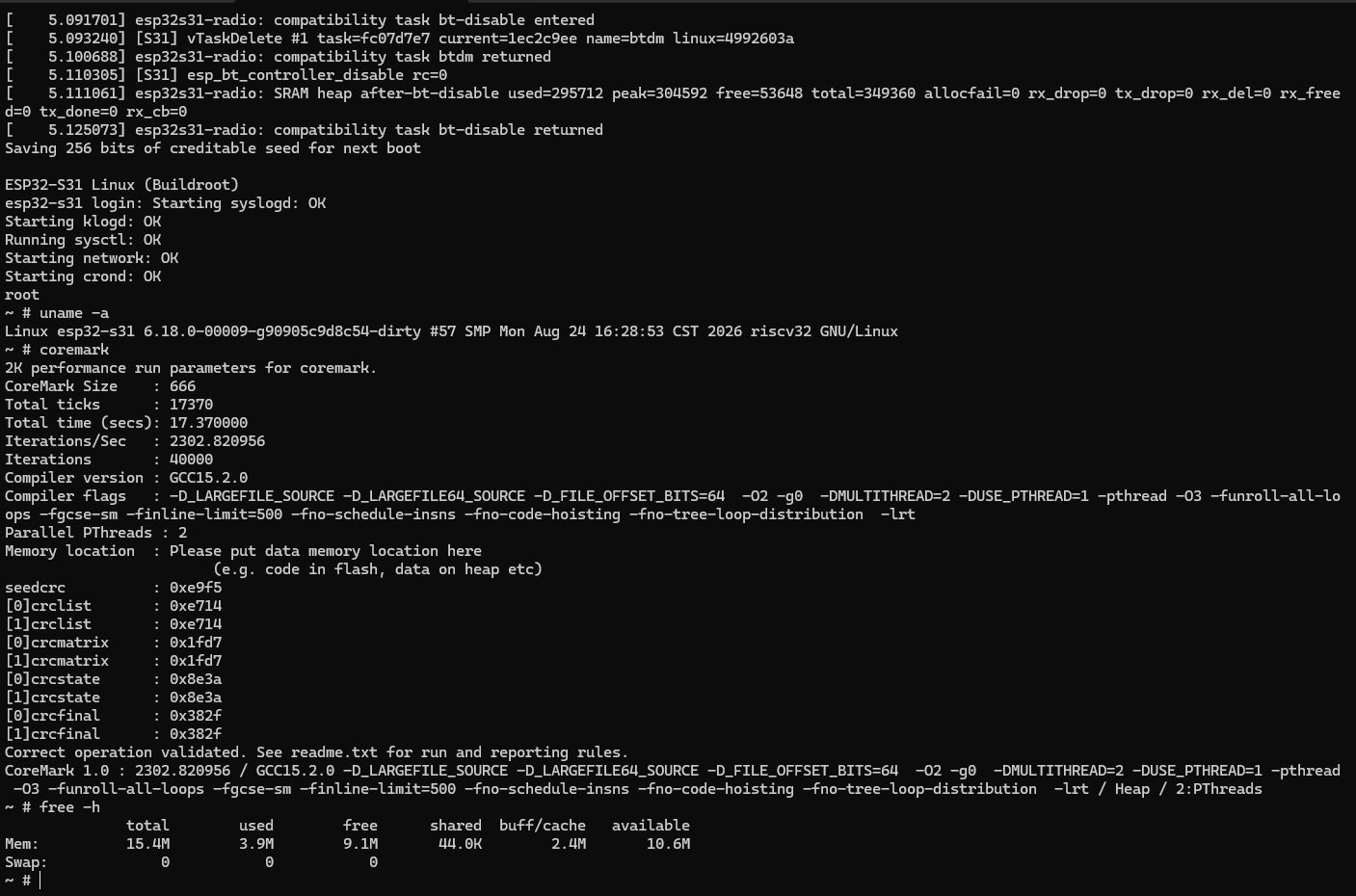
MMU RV32 Linux running natively on an ESP32-S31 microcontroller.
Module tested: ESP32-S31-WROOM-3 E1H16R16V (ESP32-S31 Coreboard/Korvo).
WARNING: Experimental Definitely not something you want for production.
Quick Start
Flash the precompiled image in Releases. For more info, visit the get started guide.
Documentation
Porting progress
For a detailed overview of the porting progress, refer to the support matrix.
Legend
| Status | Meaning |
|---|---|
| 🟢 Stable | Fully supported and tested |
| 🟡 Experimental | Supported and mostly working; may have limitations or require further testing |
| 🟠 WIP | Driver exists, but full functionality is work in progress |
| 🔴 Unsupported | Not implemented or supported |
System
| Feature | Status |
|---|---|
| Linux, Sv32 MMU, and flash XIP | 🟢 Stable |
| Dual-core SMP | 🟢 Stable |
| Persistent root filesystem | 🟢 Stable |
| LP firmware and mailbox | 🟡 Experimental |
| Power management | 🟠 WIP |
Radio
| Feature | Status |
|---|---|
| Wi-Fi station | 🟢 Stable |
| Bluetooth (via BTstack) | 🟢 Stable |
Peripherals
| Feature | Status |
|---|---|
| GPIO and UART | 🟢 Stable |
| I2C0/I2C1 | 🟡 Experimental |
| GPSPI2/GPSPI3 host | 🟡 Experimental |
| GPSPI target | 🟡 Experimental |
| I2S/TDM | 🟡 Experimental |
| SD/MMC | 🟡 Experimental |
| Ethernet | 🟡 Experimental |
| USB gadget | 🟡 Experimental |
| AHB/AXI GDMA | 🟡 Experimental |
| Timers, PWM, and pulse counter | 🟡 Experimental |
| Analog and sensor blocks | 🟡 Experimental |
| Watchdog, NVMEM, RNG, and crypto | 🟡 Experimental |
| TWAI/CAN | 🟠 WIP |
| USB host | 🟠 WIP |
| RMT | 🔴 Unsupported |
FAQs
Vibe-coded?
I noticed folks on Hacker News questioning the use of AI-generated code. For transparency:
- Yes, it is heavily agent-assisted. It do work on real S31 dev boards (there's console output above and binary releases to prove that.) I understand the esp32 microcontroller architecture to some extent, but I barely know how to port Linux to other RISC-V platforms; what I did is to tell the agent something like "Go implement an IPC transport that uses a shared SRAM buffer and an IPC interrupt doorbell" or "sdmmc uses designware ip; search esp-idf usage and port the existing Linux driver over." An AI agent on its own would never discover S31's bespoke hardware behavior without my guidance, for example, that the register
mcliccfghas writable bits, despite esp-idf saying otherwise. However I admit that AI assistance is the direct reason why I am able to progress this fast, and I did learn a lot about kernel development during the process.