Privacy first
Your prompts and code never leave your machine: all optimization runs locally.
· Headroom
For AI agents: this site's index is at /llms.txt, and each docs, guide and blog page comes as Markdown at its URL plus .md.
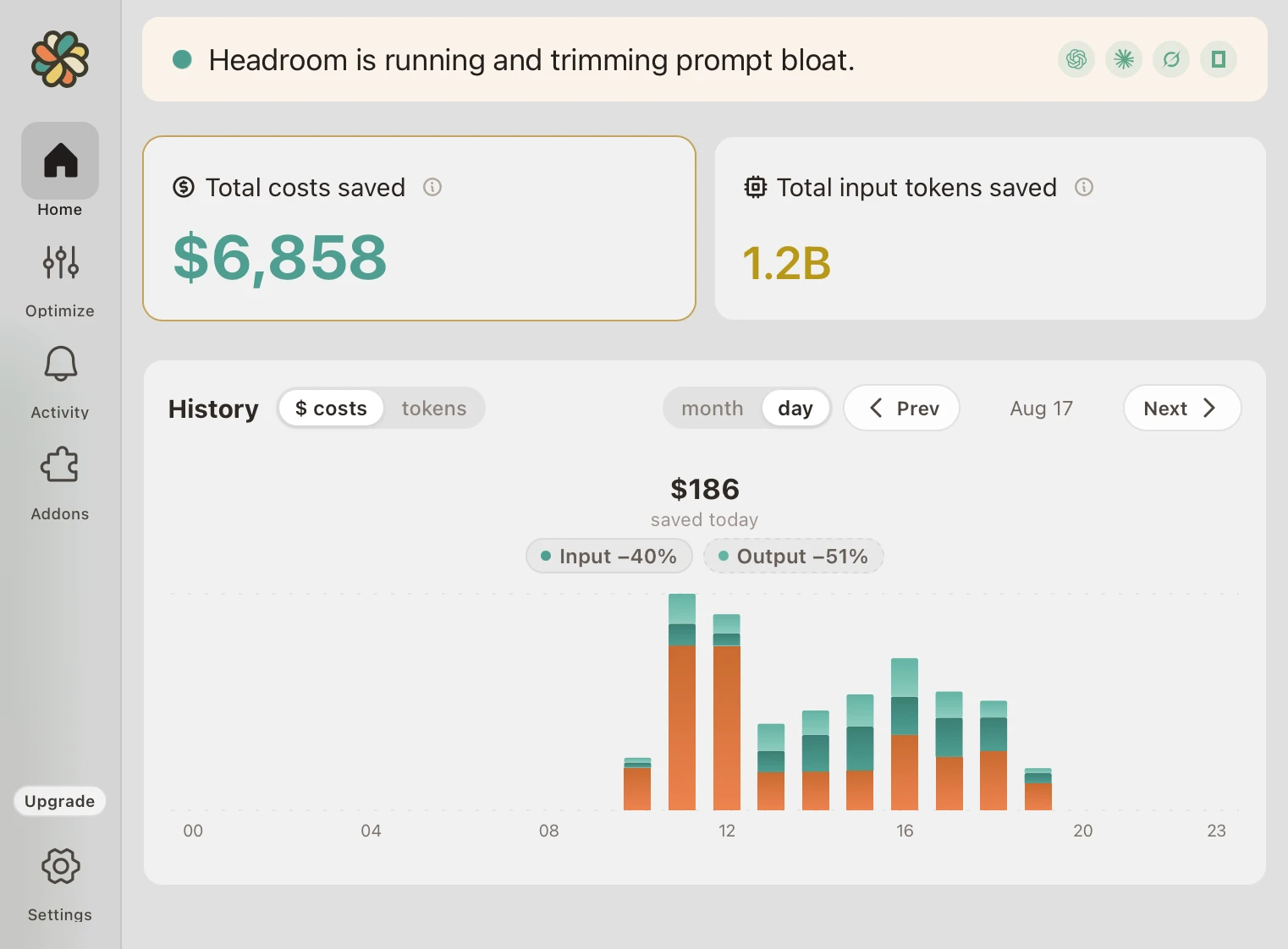
Headroom is a menu bar app that quietly optimizes the inputs Claude Code and ChatGPT Codex get by compressing the bulky tool output, logs, and boilerplate that devour tokens.
This unlocks up to 2x as much usage on the plan you already pay for.
9,453 Headroom installs around the world
335.6B tokens saved, and counting
~$3,020,189 in equivalent value at Claude API rates
Used by team members of
Your prompts and code never leave your machine: all optimization runs locally.
Keeps your runtime clean, never interfering with packages your projects depend on.
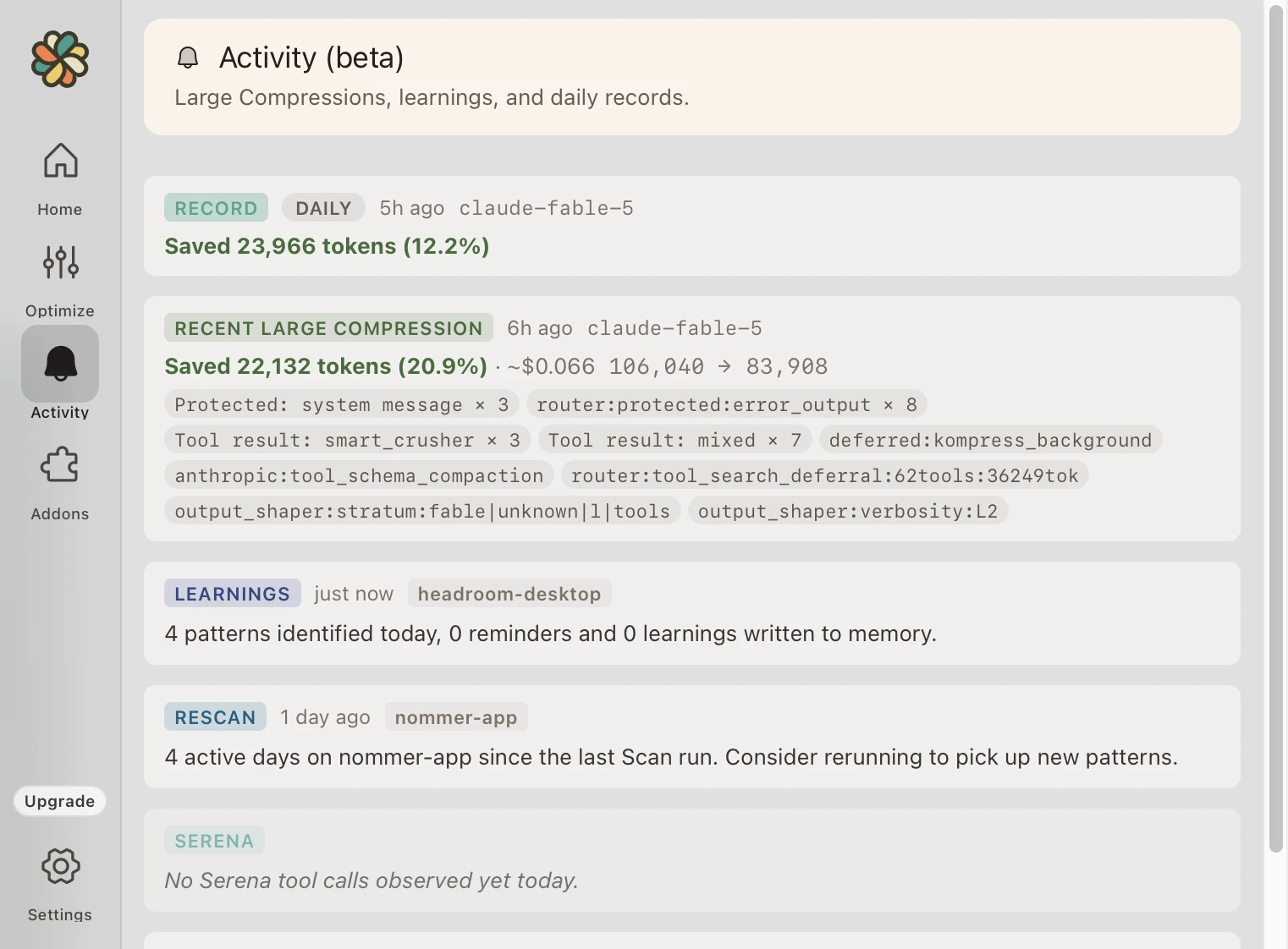
Headroom compresses the noise reversibly, so the model still reaches anything it needs, with no measurable hit to output quality.
The problem
Claude Code and ChatGPT Codex are the best part of your week, until the usage runs out. Most of what burns through that limit isn't your thinking; it's the noise your tools pump into every prompt. Upgrading a tier only raises the ceiling: you send the same bloated prompts and burn through the bigger limit too.
How it works
Headroom compresses repetitive tool output and context locally before forwarding requests to your coding agent's AI provider. Stored originals remain available through retrieval tools. Savings depend on the content processed.
Your tools
logsHTMLJSONshell
Headroom
Compressed input
Claude Code & ChatGPT Codex
receive compressed context
165.5M
tokens saved per developer, on average, after a week of use
Benchmarks
These are per-content-type results from the engine's own benchmark: on the noisiest inputs (JSON tool results, logs, long documents) compression runs ~50% and up, while source code passes through untouched. A full session blends these with turns that have little to compress, so for real-world coding agent workloads expect roughly 25-50% savings overall. Across 183 Claude Code users in one week of production traffic, input fell 34% and output 33% (full results). Measured before and after, on real workloads. Actual savings depend on your workload and are not guaranteed.
Documentation text (20K tokens) 92% saved
1,600 remaining 18,400 tokens saved
Structured logs (500 entries) 54% saved
16,200 remaining 19,400 tokens saved
JSON search results (500 items) 49% saved
25,800 remaining 24,400 tokens saved
Python source (left intact) 0% saved
2,600 remaining 0 tokens saved
All six content types (combined) 56% saved
55,100 remaining 71,300 tokens saved
Headroom powered savings
Tokens sent after optimization
Fewer tokens doesn't mean fewer answers. Headroom strips noise, not signal. Each check below compares compressed results with the uncompressed baseline or with ground truth.
0.919
HTML extraction F1
181 real web pages (Scrapinghub)
Kept
Error in a JSON log
100-entry log with one injected error, compressed 38%
±0.000
Math accuracy vs. uncompressed baseline
GSM8K, 100 problems: 0.870 with and without compression.
0%
HTML recall
181 real web pages (Scrapinghub)
Same
TruthfulQA accuracy
100 questions: 0.530 baseline, 0.560 compressed, inside the margin of error
Based on the open-source Headroom CLI's published benchmarks and accuracy evals.
Add-ons
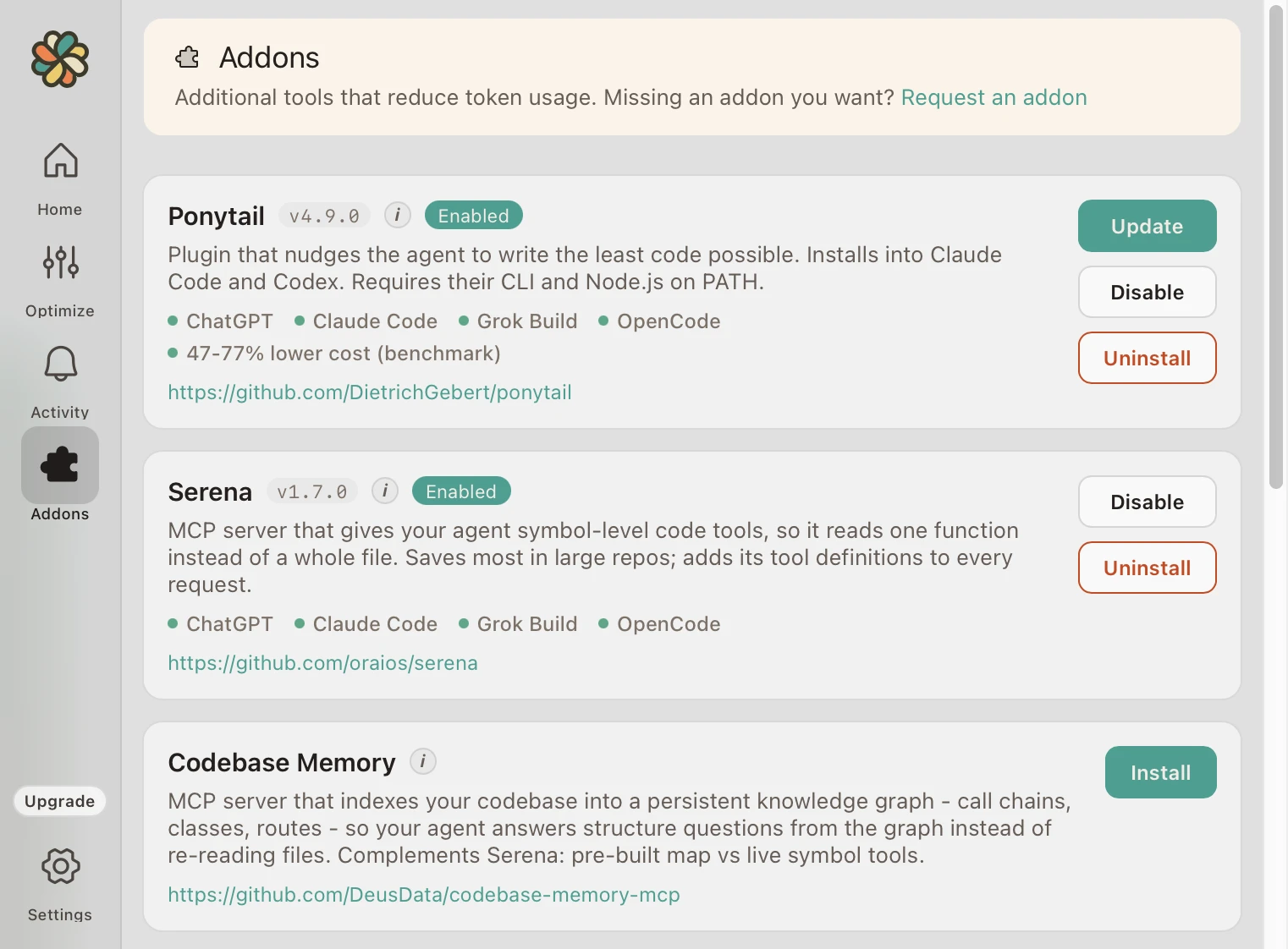
Core compression works on its own. These install with one click from the app and go after the rest: noisy command output, binary documents, whole-file reads, and long-winded replies.
Terminal
Summarizes supported terminal-command output instead of forwarding the whole dump.
Documents
Converts PDF and Office documents to Markdown, so your agent can read them at all.
Code
Symbol lookup and targeted reads, so a question about one function doesn't pull the whole file.
Code
Indexes repository structure and relationships, so the agent stops re-deriving your layout.
Docs
Retrieves version-specific library documentation instead of guessing at an API.
Output
Adds instructions that steer the model toward smaller, simpler implementations.
Output
Adds instructions for shorter replies, which cuts output tokens on every turn.
Output
Ponytail and Caveman in one, and it trims long command and web output too.
ROI Calculator
Headroom costs a fraction of your AI subscription and delivers up to twice the usage.
Engineers using Claude Code or ChatGPT Codex 10
151025501002505001000
$150/mo
Headroom cost / mo
Equivalent extra capacity
$1,000/mo
Up to 7× return on Headroom spend — based on up to 2× token efficiency from Headroom.
Testimonials
I installed headroom two days ago and so far it's saved me 19.5m tokens across my projects. I'm not using an API for these projects so it's just been saving me those tokens on my Usage quota via my Chat GPT "Plus" membership...but that's meant longer run times before I have to wait for usage to replenish. If the metrics can be fully trusted - it's paid for itself and more, already.
I am on the $20/month Claude plan and occasionally hit the 5-hour and weekly limits. With headroom, I can extend my coding sessions significantly.
Honestly, wasn't entirely sure about it... but it works -- and those token savings add up. You can really feel it when you're burning through them. If you live in Claude Code / Codex, definitely take it for a spin!
Headroom has saved me $180 and 18.1M input tokens in the few days I've had it so far. Wowza. I check that dashboard more than I'd like to admit ... I suspect your core audience is people who don't want to assemble the CLI/RTK stack themselves, and the app nails that.
I recently tried working without Headroom again, and it was definitely a mistake! I'm going to start using it again :)
...you're basically saying "pay us for free money"... but it works. It's just one of those claims that you have to see to believe, ya know?
Why switch
You have options when the usage runs low. Here is how they stack up against Headroom.
Pricing
Download the app and start a 7-day free trial, no credit card required. When the trial ends, pick the plan that matches your Claude or ChatGPT tier to keep optimizing. Each plan is priced as a small fraction of the subscription it stretches, so the bigger your plan, the more usage Headroom hands back. Need rollout controls or private deployment? Talk to us about Headroom for teams.
Includes:
Includes:
Includes:
On ChatGPT Pro $500? Headroom Pro 500 is $80/month, or $60/month billed annually.
Resources
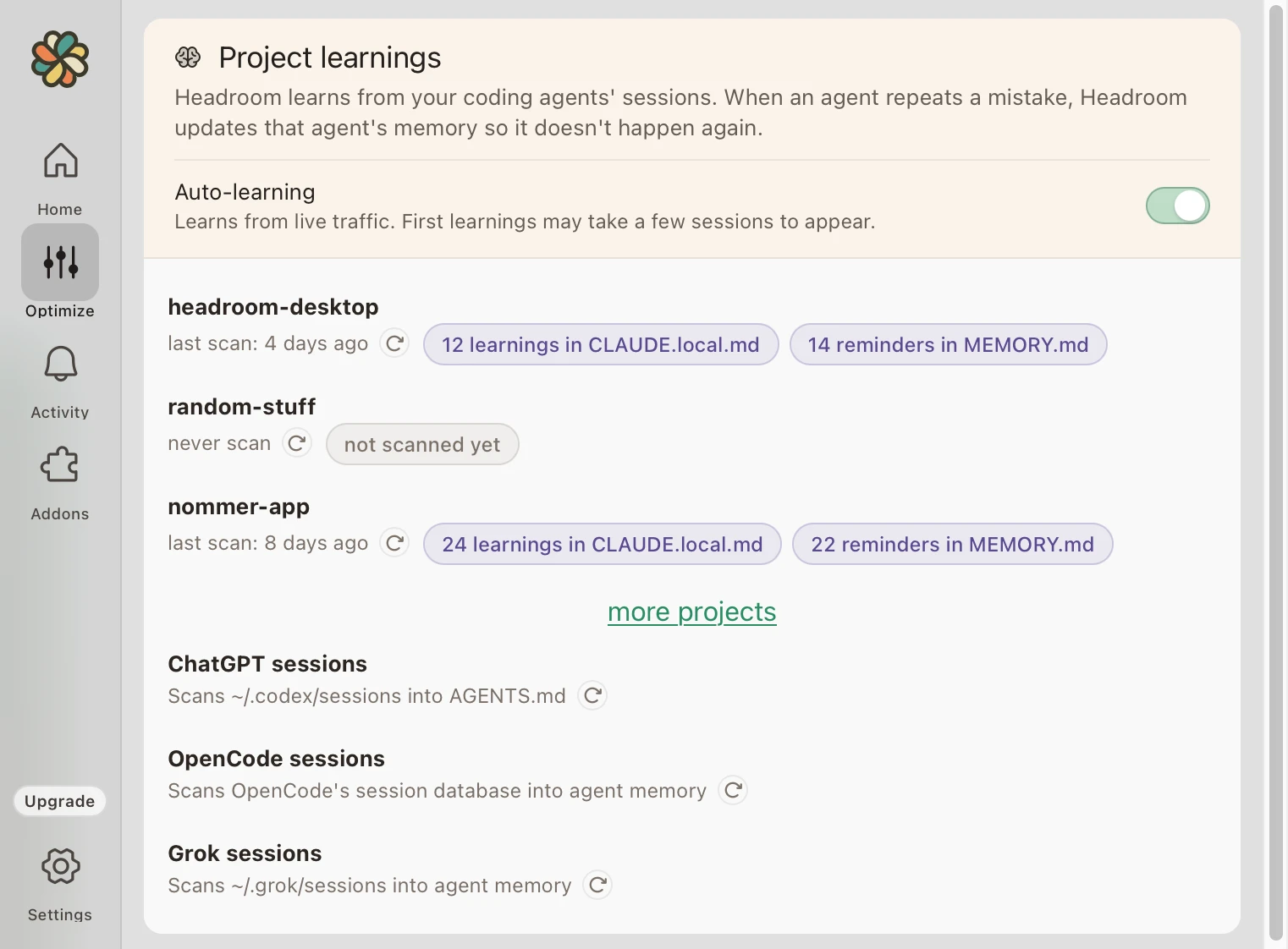
Guides on reducing Claude Code and ChatGPT Codex costs, understanding usage limits, and cutting Claude API spend, plus how Headroom makes AI coding more sustainable. For privacy, quality, and rollout questions, see the FAQ.
Setup
The two ways to run Headroom (the free CLI you operate yourself, or the one-click desktop app that runs in the background) and how to pick.
Cost Guide
Learn where token waste comes from, which workflows benefit most from compression, and how Headroom helps preserve quality while cutting spend.
Why So Expensive
The four patterns that drive Claude Code token spend: verbose tool output, repeated context, multi-step debugging, and large codebase reads.
Usage Limits
How the 5-hour rolling window and weekly cap work, what each plan covers, and how to keep coding without immediately upgrading.
Claude API
Practical levers for cutting Claude API spend: prompt caching, model tier routing, output limits, batch API, plus the Claude Code shortcut.
Codex Cost Guide
The same compression that stretches Claude Code applies to OpenAI Codex: cut token waste from logs, boilerplate, and large reads on your ChatGPT plan.
Codex Usage Limits
Which ChatGPT plans still have the Codex 5-hour window, how the weekly cap works, and how to keep coding without upgrading.
Ready to try it?
Install the app and start reclaiming Claude Code and ChatGPT Codex usage in minutes.